
Same-day delivery in ecommerce is rising, but speed alone is not enough. Learn how to optimize delivery routes, improve reliability, and scale smarter fulfillment.
Same-day delivery in ecommerce is no longer a premium feature. It is quickly becoming an expectation.
Customers today do not just compare products or prices. They compare how quickly they can receive what they order. Same-day, next-day, and scheduled delivery options now influence whether someone completes a purchase or leaves.
But speed alone does not win that decision.
What customers actually want is much simpler. They want to know when their order will arrive, and they want to trust that it will.
Over the last few years, delivery expectations have shifted quickly. What used to feel like a bonus now feels standard.
Customers expect faster delivery, but more importantly, they expect clarity. They want clear delivery windows and updates after placing an order. This shift has been driven by large marketplaces, but it now applies to almost every Shopify store, regardless of size.
For many merchants, same-day delivery feels like something they need to offer just to stay competitive.
The challenge is not offering it. The challenge is making it work consistently.
It is easy to assume that faster delivery leads to more sales. In reality, customers are not choosing the fastest option. They are choosing the one they understand and trust.
A vague promise like “delivered today” sounds good, but it leaves too many questions. What time? How late? Will it actually arrive today?
Now compare that to “delivered today between 4 PM and 6 PM.” The difference is small, but the impact is significant.
The second option gives clarity. It reduces hesitation. It makes the decision easier.
Customers are far more likely to complete a purchase when the delivery experience feels predictable.
Unclear promises create doubt. Clear timelines build trust.
Same-day delivery sounds simple from the outside, but it depends on multiple things working together.
Inventory needs to be accurate across locations. Orders need to be assigned to the right store or warehouse. Delivery routes need to make sense. Drivers need to complete multiple stops within tight timelines.
If any one of these breaks, the experience suffers.
An order might be routed from a store that is too far away. Items might not be available in one place. A driver might take a longer route without realizing it. Traffic might delay multiple deliveries at once.
These are not edge cases. They are everyday realities.
This is why many stores offer same-day delivery, but struggle to make it reliable.
The easiest way to make same-day delivery work is to reduce distance.
When orders are fulfilled from nearby stores or local hubs, everything becomes simpler. Delivery times are shorter. Routes are easier to plan. Delays are easier to manage.
For example, if a customer in Pune places an order, fulfilling it from a nearby store instead of a central warehouse can save hours.
Local fulfillment does not just make delivery faster. It makes it more predictable.
It also allows you to offer tighter delivery windows, which improves the customer experience without adding complexity.
Once an order is ready, the next step is getting it to the customer efficiently. This is where many systems fall short.
Without proper routing, drivers often take longer paths, backtrack between locations, or handle deliveries in the wrong order. This increases delivery time and cost at the same time.
A better approach is to plan routes based on what is actually happening on the ground.
Orders that are close to each other can be grouped together. Routes can adjust based on traffic. Tolls can be avoided when they do not make sense. Deliveries can be sequenced so that the driver is not doubling back.
Sometimes, items in a single order are not available at one location. Instead of sending multiple deliveries, those can be combined into one route with multiple stops. The customer still receives everything together, but the system works more efficiently in the background.
As delivery conditions change, routes should not stay fixed. Orders may need to be reassigned, priorities may shift, and routes should be easy to adjust without starting from scratch.
This is where Scrollengine helps by planning routes based on real conditions, accounting for traffic, supporting multi-stop deliveries, and allowing orders to be moved between routes when needed.
Small improvements in routing often make a bigger difference than trying to move faster.

Even if your operations are strong, the way delivery is presented at checkout still matters.
Customers should not have to guess what a delivery option means. When options are vague, people hesitate or choose the safer alternative.
Instead of showing “same-day delivery available,” it is better to show something specific. A time window, a clear cut-off, or a condition like “order within the next two hours.”
For example, “Delivered today between 4 PM and 6 PM” is far more effective than a generic same-day label.
This reduces friction and sets the right expectations from the start.
If same-day delivery is no longer possible, it should not appear as an option. Showing unavailable choices only creates confusion and breaks trust.
In practice, this means delivery options need to update based on real conditions like time, location, and availability. Scrollengine handle this directly within the cart, so customers only see options that actually apply to them.
A good checkout experience makes delivery feel simple and reliable, even when the system behind it is complex.
After an order is placed, the experience does not end. It continues until the order is delivered. This is where many delivery journeys start to feel uncertain.
If there are no updates, customers are left guessing. They check their phone. They refresh the order page. They start to wonder if something is delayed. Even a fast delivery can feel unreliable if there is no communication.
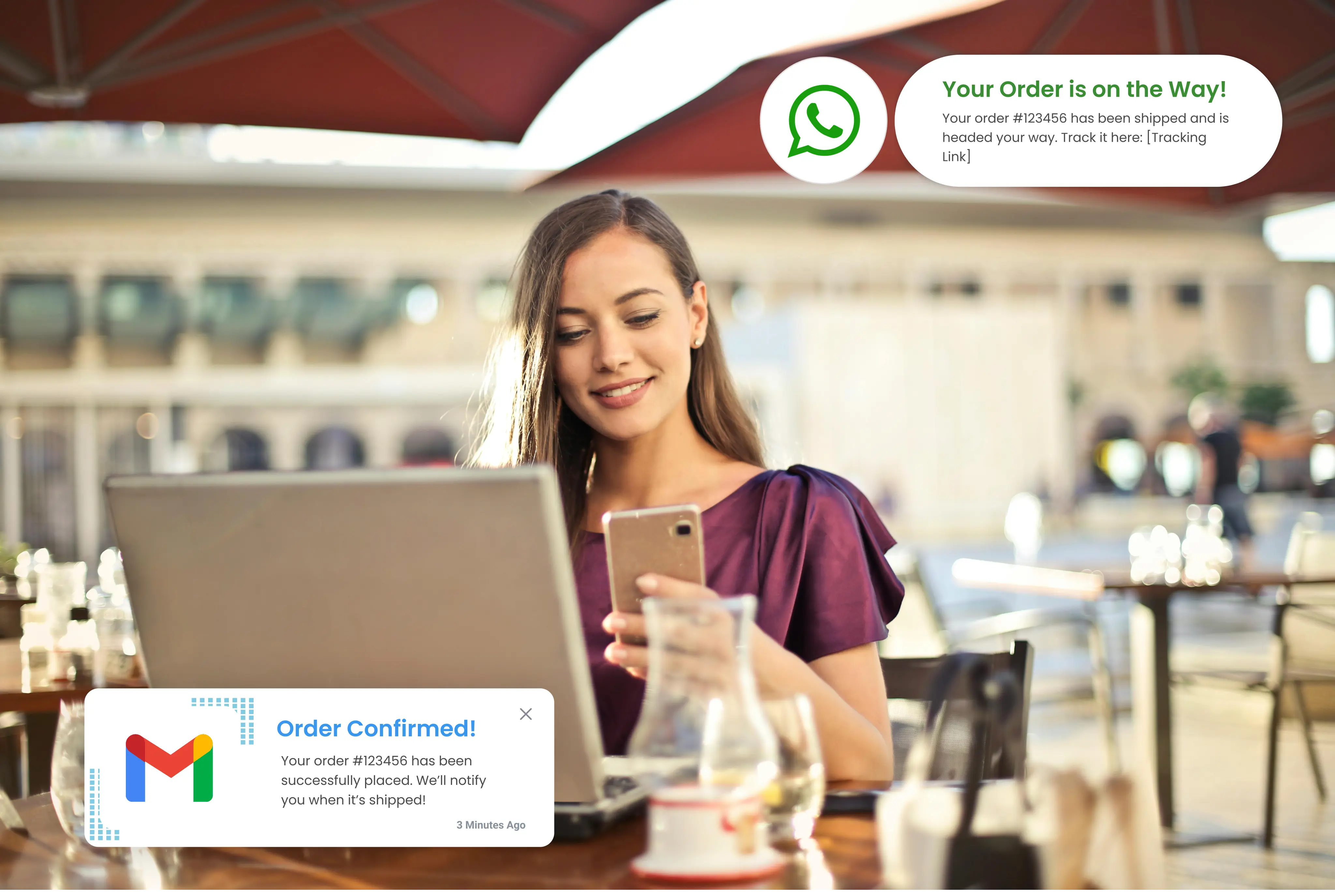
Now compare that to a simple sequence. The order is confirmed. A message says it is out for delivery. Another update shares the expected arrival window. Nothing complicated. Just clear updates at the right time. That alone changes how the experience feels.
Customer notifications do not need to be complex to be effective. They just need to be consistent and tied to what is actually happening with the order.
This is where Scrollengine fits naturally into the experience by keeping customers updated at each step, based on real-time delivery progress rather than static timelines.
When updates reflect what is actually happening, customers feel more in control. They know when to expect their order, and they are less likely to reach out for support.
Same-day delivery works best when customers are not left guessing.
They should always know what is happening.
Same-day delivery is not necessary for every business.
It works best when customers are located close to your stores, when products are needed quickly or are highly perishable, and when inventory is already distributed across locations.
If these conditions are not met, trying to force same-day delivery can create more problems than it solves.
In many cases, a reliable next-day or scheduled delivery option performs better.
The goal is not to be the fastest. The goal is to be the most dependable.
Same-day delivery often increases costs. There are more deliveries to manage, tighter timelines, and more coordination required.
If routes are not planned well, these costs can grow quickly. This is why efficiency matters.
Grouping deliveries, planning better routes, and reducing unnecessary travel can make a big difference. When operations are optimized, same-day delivery becomes more sustainable.
In practice, making this work requires more than manual coordination.
You need a system that can assign orders to the right store, plan efficient routes, and adjust those routes when conditions change.
For example, if items in an order are spread across locations, deliveries should still be combined into a single route. If traffic builds up, routes should adapt. If priorities change, orders should be easy to move without rebuilding everything from scratch.
This is the kind of delivery setup tools like Scrollengine are designed to support, so merchants can offer same-day delivery without adding operational complexity.
Same-day delivery in ecommerce is powerful, but speed alone is not what drives results. Customers are not just looking for fast delivery. They are looking for delivery they can trust.
Clear timelines, better routing, local fulfillment, and simple communication all play a role. When these come together, same-day delivery stops feeling risky. It starts feeling reliable.
Same-day delivery works best when your system can make smarter decisions in real time. From route planning to multi-stop deliveries and customer updates, the right setup helps you deliver faster without losing reliability.
👉 Explore how Scrollengine's Local Delivery + Pickup Shopify App can help you optimize local delivery and same-day fulfillment.