How Route Optimization Transforms Delivery Operations
Route optimization turns delivery planning from a morning of manual sequencing into a review…
Company news
HomeRun promises construction materials at the door in 60 minutes or less across Bengaluru, India. Its own driver fleet runs on ScrollEngine: dispatch, route optimization, live tracking and automatic customer updates.
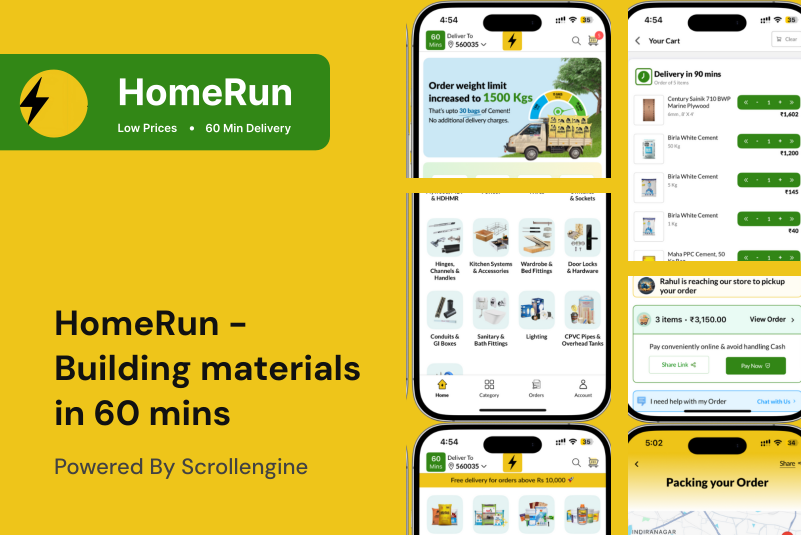
HomeRun keeps a 60-minute delivery promise for construction materials across Bengaluru, India, by running its own driver fleet on ScrollEngine. Each order goes to a nearby available driver, the route runs on live traffic, and the customer sees every step until the order reaches the door. This post shows how that promise works behind the scenes, and what any store needs in place before it promises delivery in an hour.
Just a few years ago, same-day delivery was considered cutting-edge. Now the bar has been raised. Customers no longer ask "Can it arrive today?" They ask "Will it be here in an hour?"
That shift is called quick commerce, and it is growing fast in India. Bain & Company reports that India's quick-commerce GMV has doubled every year since 2023, reaching $10–$11 billion in 2025. Bain & Company, How India Shops Online 2026 (Apr 2026) Quick commerce began with groceries and electronics, and brands like HomeRun are now bringing it to construction materials.
Imagine you're a contractor, midway through a renovation project in Bengaluru. You suddenly realize you're short on fasteners and tile adhesive. Normally you'd stop work, drive to the nearest store, sit in traffic and lose an hour or more.
With HomeRun, you open the app, choose what you need, and it arrives in under 60 minutes. HomeRun isn't just delivering materials. It's saving time on job sites, helping professionals move faster, and changing how construction supplies reach urban India.
When we first published this story in September 2025, HomeRun was live across 76+ pin codes with a catalog of over 800 SKUs, bringing on-demand delivery to a traditionally slow-moving sector.
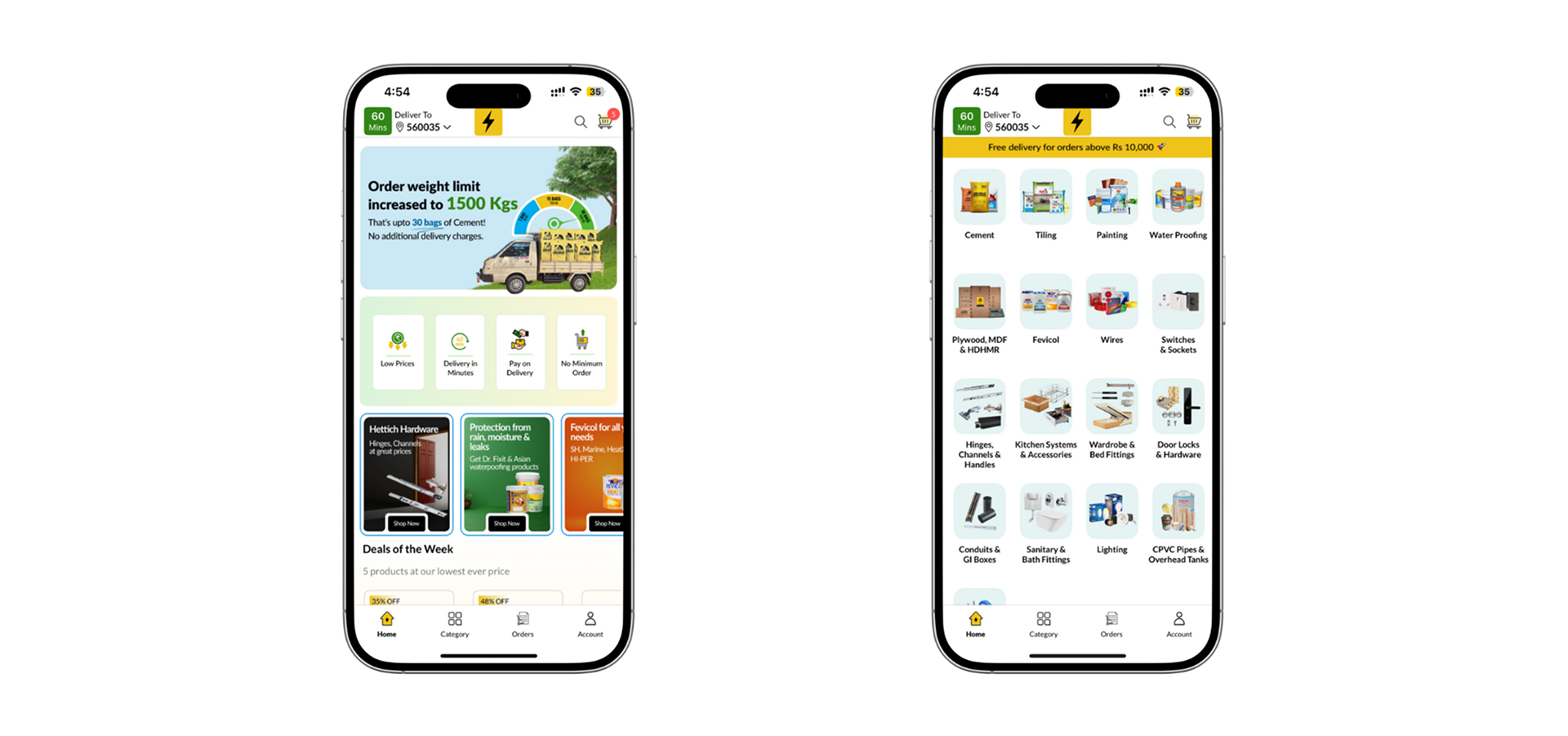
To the customer, 60-minute delivery feels simple: a few taps, and the order is at the door. Behind the scenes, it's a logistics puzzle that starts over with every order:
With orders arriving all day in a city like Bengaluru, and traffic, weather and the driver roster changing by the hour, answering these by hand puts the promise at risk on every order. HomeRun needed those answers handled by a system, and visible to its team as they happen.
ScrollEngine is the operations system behind HomeRun's fleet. It applies dispatch rules and route optimization, tracks every driver, and keeps the customer and the business in sync. Here is each part.
From the moment an order is confirmed, ScrollEngine tracks the available drivers in real time. With automated dispatch Early access, it offers the order to nearby on-duty drivers, ranked by cost and load, and whichever driver accepts first takes it. That choice shows up at once in the HomeRun app and in the operations dashboard. Nobody has to phone around to find a free driver.
Stores that aren't in the automated-dispatch early access can still post open orders to a driver job board, where drivers claim them.
Once a driver has the order, ScrollEngine's route optimization Live plans the path to the pickup point and on to the customer. It can take into account:
Time windows, shifts and capacity are route constraints, part of advanced routing, which depends on your plan. Routes can still change after a driver sets off. When the plan changes, the ETA is recalculated.
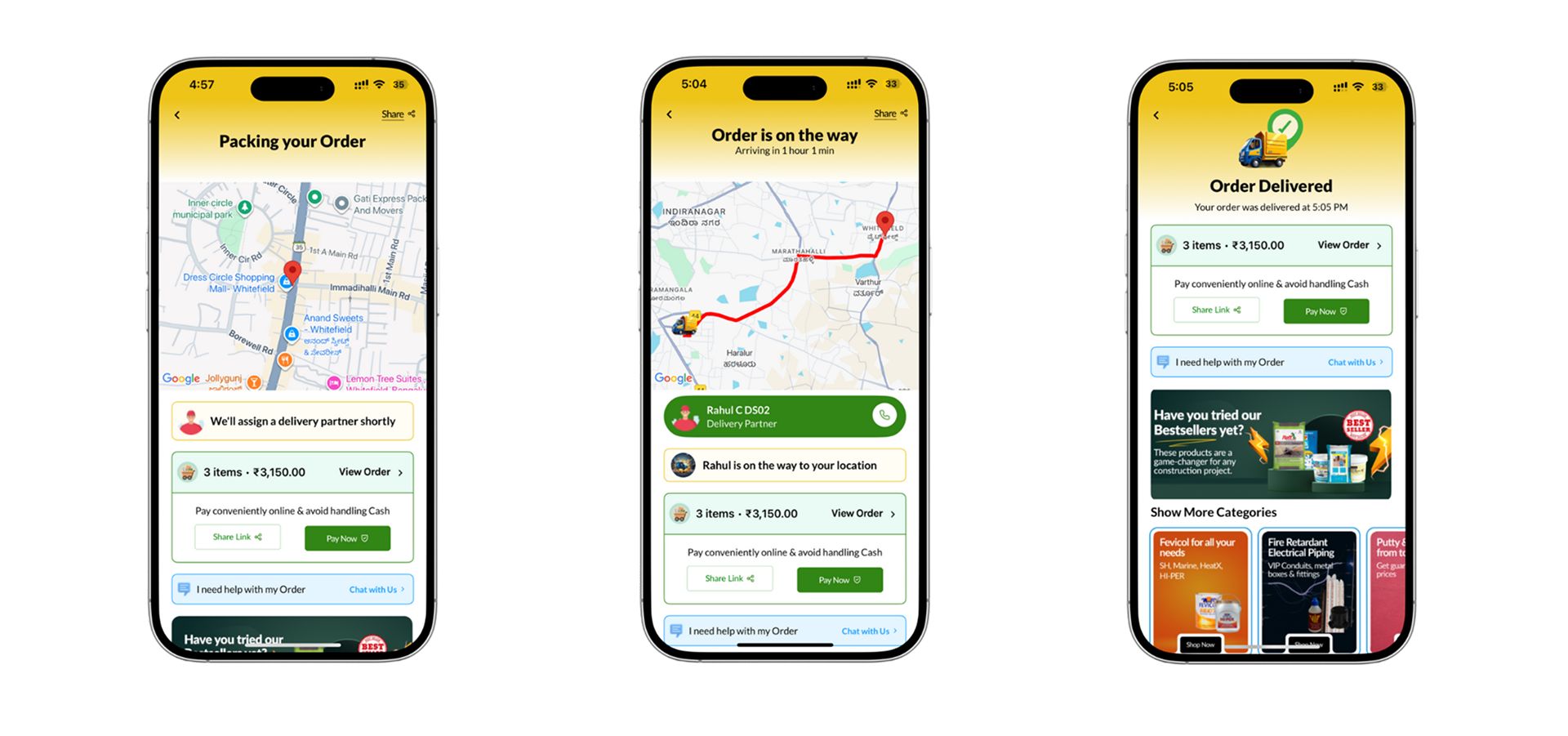
Customers get anxious when they don't know where their order is or when it will arrive. Automatic updates reach them at every step, in the HomeRun mobile app and on WhatsApp (HomeRun uses WATI for its WhatsApp messages):
Each update is clear, time-stamped and useful. Customers can also follow their driver on a live map, with an ETA that updates as the driver moves, so "where is my order?" is answered before they have to ask.
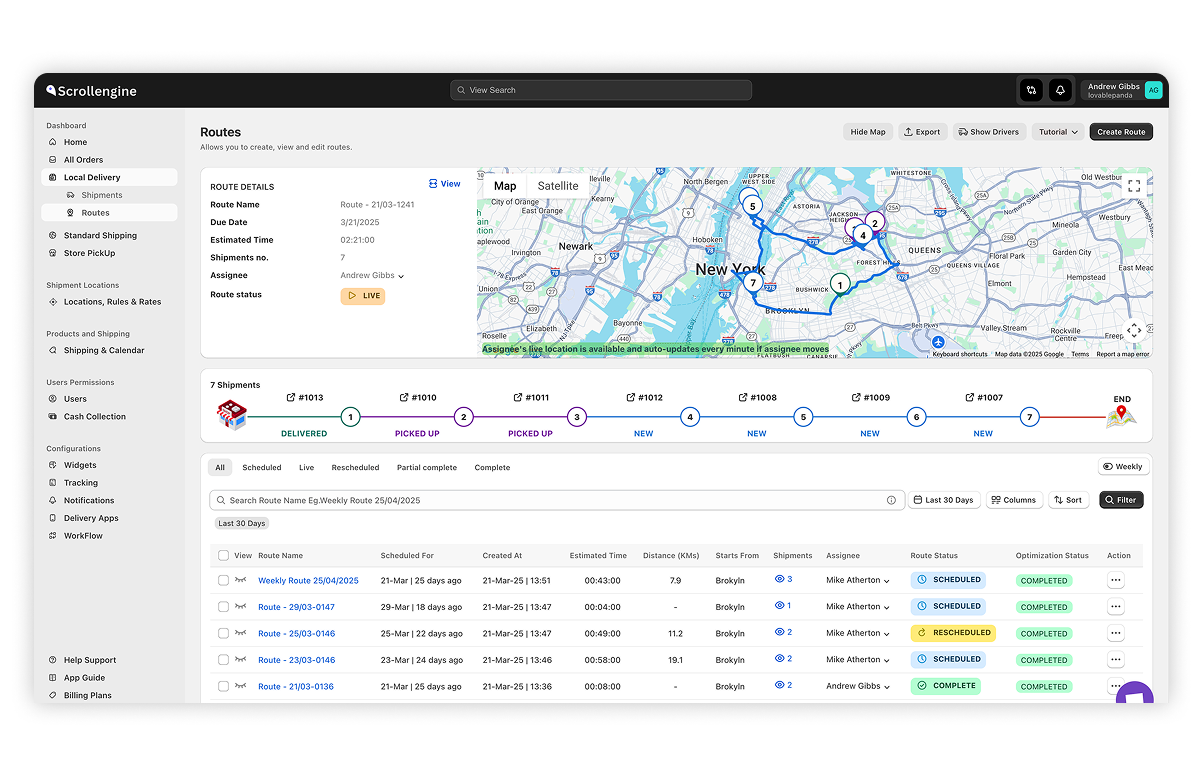
Many quick-commerce platforms rely on third-party delivery aggregators. HomeRun built its own fleet, which gives it control over quality, reliability and the brand experience. With ScrollEngine, HomeRun's team can:
The live driver map and driver scorecards are in the standalone ScrollEngine web dashboard. From one view, the team can see the whole fleet or a single driver's route on a Tuesday afternoon.
In the HomeRun app, customers see a progress bar with the delivery status, the driver's live location, an ETA countdown and quick access to support. ScrollEngine supplies the live status, location and ETA behind those screens.
That's the kind of experience that brings customers back. They may not remember the driver's name, but they remember that the order arrived when promised.
ScrollEngine runs delivery, alongside the other tools in HomeRun's stack:
| Tool | Role for HomeRun |
|---|---|
| ScrollEngine | Delivery operations: dispatch, routes, live tracking, customer updates and fleet management |
| Shopify | The commerce backend: products, orders and customer data |
| MageNative | HomeRun's native mobile shopping app, built on Shopify |
| WATI | WhatsApp messages to customers |
MageNative powers HomeRun's mobile experience: the app infrastructure and storefront. ScrollEngine handles real-time delivery, route optimization and the 60-minute fulfillment workflow. Together they make a modern quick-commerce setup on Shopify. For more on whether quick commerce can run on Shopify, read Can We Build Quick Commerce on Shopify?.
As we published in September 2025, since adopting ScrollEngine, HomeRun has been able to:
Quick commerce isn't just about moving fast. It's about moving smart, building trust, and making delivery an asset instead of a liability.
HomeRun's setup carries over to any store that wants to promise delivery within the hour. Here's the checklist we'd start with:
Whether you're launching a delivery-first business or scaling your own fleet, ScrollEngine gives you:
To build a quick-commerce experience you can scale with confidence, clarity and control:
FAQ
HomeRun delivers building materials, tools, fittings and hardware to contractors across Bengaluru, India, and promises them at the door in 60 minutes or less. Its own delivery fleet runs on ScrollEngine. Read the short HomeRun case study.
ScrollEngine tracks HomeRun's available drivers live, gets each order to a nearby driver, routes the driver through live traffic, and keeps the customer updated automatically from order confirmed to delivered. Dispatchers follow the whole fleet on the live driver map in the standalone ScrollEngine web dashboard, with alerts when a delivery is close to running late.
Its own fleet. When we published this story in September 2025, HomeRun ran more than 70 drivers instead of relying on third-party aggregators, which keeps quality and the delivery experience in its own hands.
Yes, if the operation is built for it: a tight delivery zone, stock close to customers, drivers who can take orders the moment they come in, routing on live traffic and customers who are kept informed. HomeRun's store runs on Shopify. ScrollEngine is an app for Shopify merchants with a 7-day free trial.
Quick commerce, or q-commerce, is ordering online for delivery in under an hour, often much faster, from stock kept close to customers in small stores or dark stores. It began with groceries and electronics. HomeRun applies it to construction materials in Bengaluru. For whether it can run on Shopify, read Can We Build Quick Commerce on Shopify?
From the blog
Route optimization turns delivery planning from a morning of manual sequencing into a review…
Most Shopify stores need five local delivery tools: zones and rates, a date and time slot picker with limits…
ScrollEngine, our app, does the whole job in one app: delivery slots at checkout…
Book a demo and we'll walk you through the platform set up like your stores, or request a quote for your locations and how you deliver.
2,000+ merchants trust us (as of Oct 2026)100+ merchants rate us 5.0 stars on the Shopify App Store (as of Oct 2026)